Strategy Quantification
Chapter 4 Recap
Welcome back to the growth strategy series. In our last chapter, we discussed how to develop and articulate a growth strategy at a high-level. It covers the development of brutal truths, as well as key elements of a well-articulated strategy such as a purpose, vision, financial objective, strategic imperatives, and enablers. Key takeaways are as follows:
- The growth strategy development stage establishes concise vision and purpose, core values and competencies, and financial objectives.
- Data-backed insights, implications, and brutal truths drive strategic decision-making and create competitive advantage.
- Imperatives and enablers build on insights, implications, and brutal truths by identifying the key strategic choices that need to be made and what supports them.
- Strategy development sessions are highly collaborative and best held in person. We recommend keeping an open mind and thinking unconstrained.
This chapter covers strategy quantification: how to identify, analyze and assign value to the underlying initiatives supporting each imperative to ensure we’ve set a course to deliver on our financial objectives.

Chapter 5: Strategy Quantification
Introduction
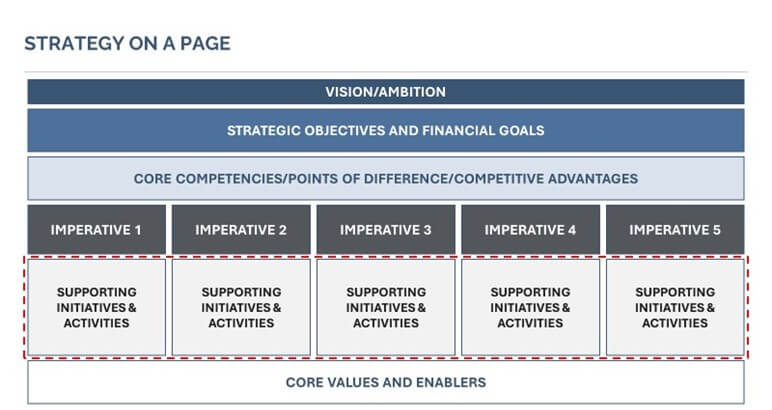
Strategy quantification breaks down the high-level imperatives defined during the strategy development & articulation stage into tactical, actionable, and measurable initiatives (a.k.a. projects). Typically, we recommend anywhere 5-7 initiatives underlying each imperative. However, that number can vary based on size, complexity or needs of the organization. As a reminder, see a sample strategy on a page graphic below. This chapter focuses on “Supporting Initiatives & Activities”
Team Composition: Roles and Responsibilities
A reminder of the sample governance structure covered in the Strategy Readiness chapter:
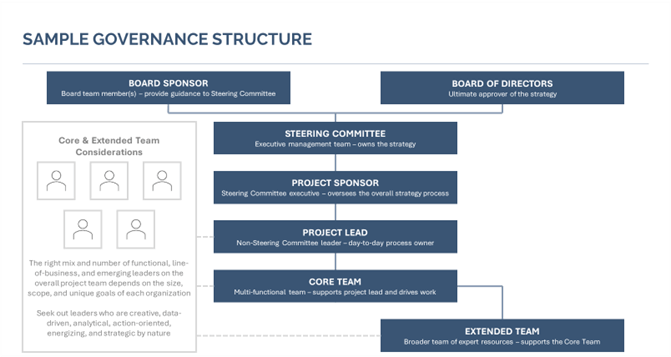
Strategy Quantification is typically managed by the Core Team and Extended Team, but the group re-organizes by each strategic imperative, with key roles as follows:
- Imperative Champion: Typically a member of the steering committee, the Imperative Champion provides guidance and leadership to the imperative lead and team
- Imperative Lead: This individual, often a core team member, is tasked with identifying and organizing a team to brainstorm, develop and quantify the supporting initiatives to each strategic imperative. This individual is usually (but not always) responsible for the eventual execution of the overall strategic imperative
- Imperative Team: Typically a combination of core team and extended team members, the imperative team brainstorms, develops and quantifies the supporting initiatives to each imperative. Similar to the imperative lead, depending on how the team is constructed, certain imperative team members often take ownership of the tactical execution of the supporting initiatives
- Initiative Lead: Members of the imperative team assigned to take ownership of each individual initiative. One individual can be the lead for multiple initiatives.
Timeline and Time Expectations:
The timeline for strategy quantification varies, but we recommend anywhere from 6-8 weeks. Brainstorming and identifying the key initiatives to target in support of each imperative may only take 1-2 weeks, but significant time should be spent on quantification: researching and pressure-testing assumptions, conducting scenario analysis, and evaluating risks and dependencies to align on a projected outcome.
Team member bandwidth also plays a role in dictating the timeline for strategy quantification. While we recognize team members have day-to-day responsibilities, we urge the imperative teams to elevate initiative development and quantification as a top priority item, with dedicated time assigned throughout the day and week. Initiative development should not be taken lightly; the process directly impacts how your organization invests capital, resources and talent in the coming years, and it sets expectations for what those investments will deliver.
We recommend customizing the process to best meet your needs, but the following sections cover high-level steps to consider.
Step 1: Initiative Inventorying and Brainstorming (1-2 Weeks)
Once teams are formed, start by capturing the work already in process. Take inventory of ongoing projects and activities that are in support of the strategic imperatives, as well as the ones that aren’t; strategy is about clarifying focus and making choices, so be sure to highlight the “non-strategic” projects that can be discontinued to repurpose resources for more high-impact work.
Once you’ve considered the existing work, encourage the imperative team to brainstorm the potential tactical initiatives that could support the imperative. These could be “wish list” items they’ve wanted for a long time, or entirely new ideas and opportunities that present themselves. Encourage creative but actionable and realistic thinking during this stage, as we are nearing execution. At the same time, try not to dismiss any “small” ideas. The purpose of this step is to get all the options down on a page – prioritization comes later.
Step 2: Initiative Prioritization (1-2 Weeks)
Once all options are laid out, begin prioritizing. A common pitfall at this stage is to evaluate every initiative in detail to estimate a potential impact before prioritizing; in a perfect world the bandwidth exists to do that, but time and resource constraints usually make that infeasible. Our recommendation is to initially evaluate each initiative on a qualitative or ranged scale across a few key criteria, such as…
- Rough Size of Prize: Once the full impact is achieved, what will this initiative be worth from a revenue or profit standpoint?
- Investment Required (CAPEX, FTEs, other): What investment is required to complete this initiative?
- Time-to-value: How long will it take to realize the value of this initiative?
- Alignment to Imperative: How well does this initiative support, and align to, the strategic imperative?
- Risk: What risks, dependencies and considerations exist that we should consider?
These criteria can be evaluated on a strictly qualitative basis (High / Medium / Low), or with rough ranges in dollar amounts assigned. What is most important is that the imperative team reviews, discusses and evaluates each initiative. That discussion typically leads to a natural prioritization, where the group aligns on the high priority / high impact initiatives and sets aside the low priority ones.
Through this process, you may also realize you have identified some initiatives that better align to a different strategic imperative. Pass those along to the appropriate imperative team as necessary.
Step 3: Detailed Initiative Quantification (4-6 weeks)
Next, quantify each priority initiative in detail – essentially, develop a data-backed business case. At this point, consider dividing the effort. Identify a lead for each initiative to evaluate and build the financial case. Initiative leads should build a forecasted business case (aligned to the time horizon of the strategic plan) that considers…
- P&L impacts: Revenue, COGS, Operating Expense / SG&A (including depreciation if you plan to model on an Operating Income basis)
- CAPEX: Capital investment required (related depreciation should be captured in the P&L impact)
- FTEs / resources: Incremental full-time employees required to execute, including their departments / job titles / skills required (related salary and benefit assumptions should be captured in the P&L impact)
- Risks and dependencies: Risks to executing the initiatives, or any other dependencies or related initiatives that support successful execution
Detailed quantification is challenging and requires several assumptions, so we’ve included a few best practices to consider when quantifying each initiative…
- Look externally: Do any case studies or proxies exist where companies have taken on a similar initiative?
- Look internally – use historical data: Has the organization taken on similar initiatives in the past? What were those worth? Can we deliver similar results?
- Leverage sensitivity and scenario analyses: Rather than defining static assumptions, apply a range and build sensitivity analyses or scenarios. Gather perspective from other experts in your organization to build a perspective on what potential outcomes seem feasible
- Cold call: You’d be surprised the amount of information you can get by simply calling the right people and asking the right questions
As part of initiative quantification, each initiative lead should organize their initiative detail in a charter that details the financial impact, investments required, key next steps, timing, risks, dependencies, and other considerations. These initiative charters are critical as the strategy moves into execution.
Once all initiatives have been quantified across all imperatives and totals have been aggregated, compare the output against the financial objectives you set earlier in the process. If you fall short, consider either pressure-testing assumptions to be more aggressive, or re-assessing your financial objectives.
Step 4: Aggregation and Financial Bridge Development
As initiatives are quantified, a model will be required to collect all inputs. Identify an individual from the core team (potentially a Finance resource) to build a strategy quantification model that aggregates the P&L impacts, capital investments, FTEs, and any other relevant inputs. Make sure each initiative lead provides inputs at the level of detail that can be consumed by the model. With numerous individuals quantifying initiatives, differences in detail cause challenges creating a consolidated output.
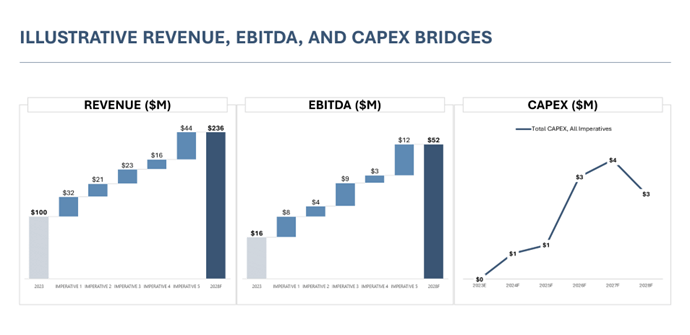
Align on a “Base Year” as the starting point of the strategy – typically trailing 12 months or the last fiscal year. Growth initiatives identified by the imperative teams should build upon the base year P&L. The key outputs of the strategy quantification model are time-phased revenue and earnings bridges and annual capital spend estimates, beginning from the base year and extending through the strategy horizon. See below for illustrative bridges (note that bridges can be reflected by year, imperative, or any other level of detail available):
Step 5: Strategy Approval and KPI Development
Finally, once the strategy has been quantified and aggregated, gaining board approval and alignment is critical. The project sponsor and steering committee should present a summarized strategy output to the board and make any necessary adjustments based on board feedback.
With board input, the steering committee should develop a set of key performance indicators (KPIs) used to track ongoing execution and realization of the strategy. KPIs can be defined at the overall strategy as well as individual imperative level, but make sure KPIs are choiceful, fit-for-purpose and accurately reflect the intended outcomes of the strategy. Effective KPIs go beyond just measuring activity, and track progress towards achieving objectives. Ongoing measurement and evaluation of KPIs plays a critical role in strategy execution.
Takeaways and What’s Next
- Be sure to dedicate enough time to brainstorming, evaluating, and vetting the supporting initiatives underlying each imperative
- Cast a wide net and prioritize early – don’t burn energy building a detailed quantification of a laundry list of potential initiatives
- Divide the effort by assigning initiative leads to quantify each initiative, but be clear on the level of detail required; differing levels of detail create challenges aggregating and building a consolidated output
- Develop an aggregated long-term view with revenue and earnings bridges and annual capital spend plans. Gain board alignment with a specific set of KPIs identified for measurement
In our next chapter, we discuss strategy execution. For questions about this piece, coming installments, or how we can help at any stage of strategy development, contact Mike Gill, Senior Consultant, or Pieter Rhynhart, Consultant, at Denneen & Company.
Denneen & Company is a growth strategy consulting firm that has been helping companies find and follow their unique paths to growth for over years. With experience across 20+ industries, 40+ consumer categories, and 40+ countries, Denneen & Company consultants leverage their former backgrounds as industry practitioners and past engagements to develop practical and achievable strategies based on rigorous analysis, breakthrough insights, and a collaborative approach. To learn more, please visit denneen.com.